Agriculture · California
The truffle market in California
This market report includes several types of businesses like suppliers of truffle tree seedlings and equipment, restaurants serving California truffles and truffle orchards in California.
- Edition
- 2026 edition
- Format
Key findings
- There are no official USDA or CDFA statistics on truffle acreage, production or value; the best indicators come from voluntary grower surveys.[3]
- Extension guidance puts first truffles between the fourth and ninth year after planting; surveyed North American orchards averaged 7.7 years.[1][2]
- The Périgord black truffle is the most cultivated species in North America, and contamination by lower-value species is a documented risk.[4][7]
- California research projects are testing truffle cultivation, including inoculation of native Engelmann oak seedlings.[6]
Market overview
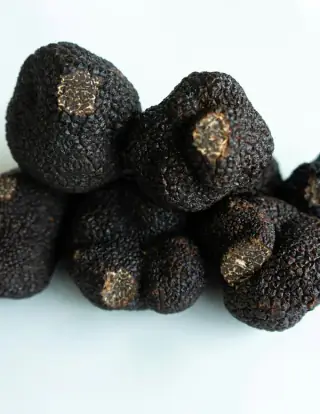
« Truffle » is the name given to a certain type of luxury mushroom that belongs to the tuber family of fungi. Truffles are mostly harvested in Southern Europe and China and can reach extremely high prices. Truffles are used sparingly, they can be consumed raw or shaved over warm and simple foods, inserted into meats, or used to give their particular flavor to butter or oil.
The main truffles that are consumed in the U.S are the following:
- the “Black truffle” or Tuber melanosporum
- the “Black summer truffle” or Tuber aestivum
- the “White truffle” or Tuber magnatum
- the “Oregon black truffle” (Leucangium carthusianum)
This market report includes several types of businesses like suppliers of truffle tree seedlings and equipment, restaurants serving truffles, truffle orchards in California and European truffle exporters.
While truffles can be found in several States in the U.S such as Oregon, North Carolina, or Washington; the rich soil and mild climate that can be found in several counties in California is ideal for truffles and grapes.
Once inoculated with black truffle spores, newly planted trees begin producing truffles after 6 to 10 years. However, it takes a lot longer to get a return on investment and there are no guarantees of success.
While the California truffle industry is still in its nascent stage, orchards are flourishing across the state which holds a growing base of enthusiasts. The Napa truffle festival is hosted in California since 2010 and provides a platform to share knowledge among the growing number of farmers across the state.
In California, the main harvest comes from the French black Périgord truffles, also called “black diamond” even if some rare findings of Burgundy truffles (Tuber uncinatum) have been reported in Sonoma County.
Verified market indicators
Each figure links to its official source. Data periods and retrieval dates are shown so you can judge recency.
1NC State Extension states that the first truffles should appear between the fourth to ninth year after planting.
Source: NC State Extension, New Crops & Organics (Jeanine Davis), Black Périgord Truffles in NC (updated July 8, 2025) · Period: Guidance current as of July 2025 page update · Geography: North Carolina / southeastern U.S. · Retrieved October 20, 2026
2In the North American Truffle Growers Annual Report 2023, the average orchard age at the time of first truffle production for all species was 7.7 +/- 2.8 years (30 responses).
Source: University of California Agriculture and Natural Resources (UCCE Central Sierra); authors Allen, Berch, Oviatt, Bonito, Long, Upchurch, Scanlon, and Oneto, North American Truffle Growers Annual Report 2023 (Allen et al., 2024) · Period: Survey reporting period November 2022 - October 2023 (report published 2024) · Geography: North America (U.S. and Canada) · Retrieved October 20, 2026 · Trade or survey source; see notes
3Respondents to the 2023 North American truffle grower survey reported 528.52 total orchard acres (270.83 post-production and 257.69 pre-production), with an average orchard size of 4.85 acres (109 responses).
Source: University of California Agriculture and Natural Resources (UCCE Central Sierra); authors Allen, Berch, Oviatt, Bonito, Long, Upchurch, Scanlon, and Oneto, North American Truffle Growers Annual Report 2023 (Allen et al., 2024) · Period: 2022-2023 reporting period · Geography: North America · Retrieved October 20, 2026 · Trade or survey source; see notes
4The North American truffle grower reports describe the black truffle (Tuber melanosporum) as the most cultivated truffle species in North America.
Source: University of California Agriculture and Natural Resources (UCCE Central Sierra); authors Allen, Berch, Oviatt, Bonito, Long, Upchurch, Scanlon, and Oneto, North American Truffle Growers Annual Report 2023 (Allen et al., 2024) · Period: 2022-2023 · Geography: North America · Retrieved October 20, 2026 · Trade or survey source; see notes
5A University of California Cooperative Extension project funded by Western SARE states that truffles typically do not appear until at least seven years after orchard establishment, with black Périgord truffles selling for over $1,000 per pound.
Source: Western SARE (USDA NIFA-funded Sustainable Agriculture Research and Education program); PI Scott Oneto, University of California Cooperative Extension, Training Truffle Growers to Optimize Field and Laboratory Techniques for Increased Production (project WPDP26-014) · Period: Project funded 2026; projected end 05/31/2027 · Geography: United States (California-led project) · Retrieved October 20, 2026 · Trade or survey source; see notes
6A Western SARE farmer/rancher project in Alpine, California reports about a 50% successful inoculation rate of native oak seedlings with Périgord black truffle using minced fresh truffle fruit bodies, and describes itself as the first report of inoculating native Engelmann oak with Périgord black truffle.
Source: Western SARE (USDA NIFA-funded Sustainable Agriculture Research and Education program); grantee Meristem LLC (PI Charlie Chen), Alpine, California, Regeneration of native California oak trees with black truffle cultivation (project FW24-005) · Period: Project awarded 2024; projected end 06/30/2026 · Geography: Alpine, California · Retrieved October 20, 2026 · Trade or survey source; see notes
7Peer-reviewed molecular analysis confirmed fruiting bodies of the lower-value European truffle Tuber brumale from ten truffle orchards across six eastern U.S. states in winter 2021, likely introduced with the original inoculum of T. melanosporum host trees.
Source: Mycorrhiza (Springer); Lemmond, Sow, Bonito, and Smith (University of Florida; Michigan State University), Accidental cultivation of the European truffle Tuber brumale in North American truffle orchards. Mycorrhiza 33(4):221-228 (2023). doi:10.1007/s00572-023-01114-8 (abstract read via PubMed PMID 37330423) · Period: Winter 2021 harvest; published 2023 · Geography: Eastern United States (six states) · Retrieved October 20, 2026
Market segmentation covered
The report profiles businesses in each segment. One example per segment is shown here.
Truffle orchards in California
Includes Jackson Family Wines and others
Suppliers of truffle tree seedlings and equipment
Includes New World Truffleres Inc and others
Restaurants serving California truffles
Includes Saison and others
European truffle exporters active in California
Includes Urbani Truffles and others
Table of contents
1.Size and growth of the market
2.Consumer behavior
3.Latest trends
4.Market shares and major companies
5.Offer analysis
6.Regulation
7.Distribution channels
8.Prices
Questions this report answers
- How large is the truffle market in California, and how has it changed?
- Which companies operate in each segment of the California truffle value chain?
- What are the main consumer and buyer trends?
- How do regulation and distribution channels shape the market?
- What price levels and pricing dynamics should a new entrant expect?
Who this report is for
- Entrepreneurs evaluating a truffle business in California
- Suppliers and service providers looking for customers in this market
- Investors and lenders assessing companies or projects in the sector
- Consultants preparing market or due diligence work
Scope, methodology and limitations
Geography: California. Segments covered: Truffle orchards in California; Suppliers of truffle tree seedlings and equipment; Restaurants serving California truffles; European truffle exporters active in California.
Our general approach is described in the research methodology.
Limitations
Figures come from the official and industry sources cited in the report, at the latest release available when it was last updated. Company lists are reviewed at each update, but a business can change ownership, move or close in between.
Data sources
- Mycorrhiza (Springer); Lemmond, Sow, Bonito, and Smith (University of Florida; Michigan State University): Accidental cultivation of the European truffle Tuber brumale in North American truffle orchards. Mycorrhiza 33(4):221-228 (2023). doi:10.1007/s00572-023-01114-8 (abstract read via PubMed PMID 37330423)
- Western SARE (USDA NIFA-funded Sustainable Agriculture Research and Education program); grantee Meristem LLC (PI Charlie Chen), Alpine, California: Regeneration of native California oak trees with black truffle cultivation (project FW24-005)
- Western SARE (USDA NIFA-funded Sustainable Agriculture Research and Education program); PI Scott Oneto, University of California Cooperative Extension: Training Truffle Growers to Optimize Field and Laboratory Techniques for Increased Production (project WPDP26-014)
- NC State Extension, New Crops & Organics (Jeanine Davis): Black Périgord Truffles in NC (updated July 8, 2025)
- University of California Agriculture and Natural Resources (UCCE Central Sierra); authors Allen, Berch, Oviatt, Bonito, Long, Upchurch, Scanlon, and Oneto: North American Truffle Growers Annual Report 2023 (Allen et al., 2024)
Delivery
PDF report, Excel file with company lists and raw data. Download from your account after verified payment.
Single-user license
One named person may use the report for internal business purposes. Quoting short excerpts with attribution is permitted. License terms
Updates
Kept up to date: the report is revised as new official data is released.
Frequently asked questions
How do I pay?
Checkout is handled by Stripe, which accepts major credit and debit cards and other payment methods shown at checkout. You do not need an account to buy. Prices are in U.S. dollars.
How and when do I receive the report?
As soon as Stripe confirms your payment, usually within a minute, the report appears in your account library and we email you a secure sign-in link. Downloads use short-lived links generated each time you click, so you can download again whenever you need to.
What file format will I receive?
Reports are delivered as PDF files. Where a report includes a data appendix, it is provided as an Excel or CSV file, as listed on the report page.
What can I do with a report under the license?
The standard single-user license lets one person use the report for internal business purposes and quote short excerpts with attribution. Sharing the file or posting it publicly is not allowed. See the license terms; contact us for team access.
Can I use a discount code?
Yes. When we offer promotion codes, enter them on the secure Stripe checkout page.
Do you charge sales tax?
Where we are required to collect tax on digital products, it is calculated at checkout based on your billing address. Rules differ by state.
Can I get an invoice for my company?
Stripe emails a receipt for every purchase. If you need an invoice with specific company details or purchase-order terms, contact us before or after purchase.